
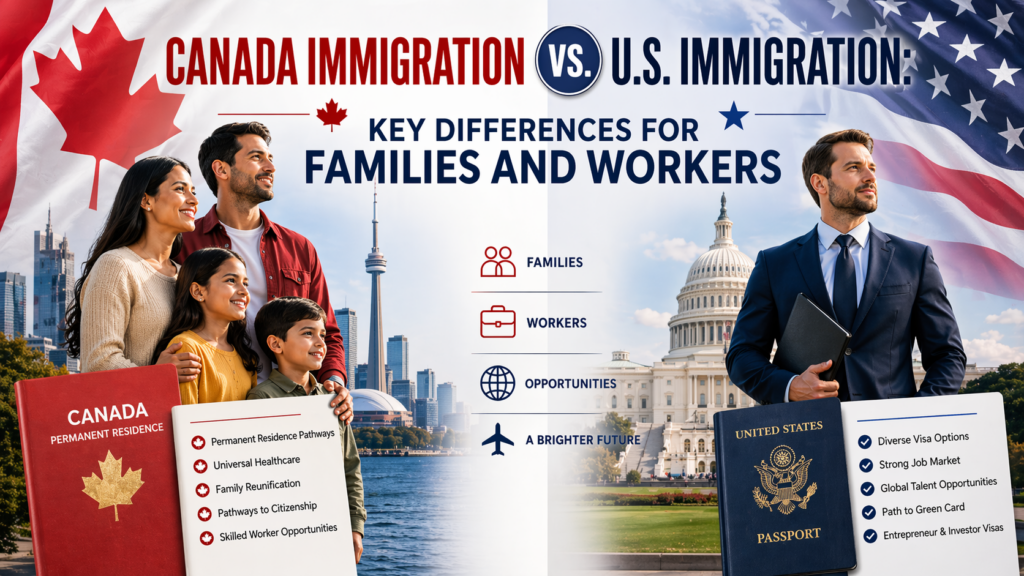
Introduction
People in the United States often search for canada immigration when comparing legal systems, exploring outbound relocation, or trying to understand whether a foreign immigration model offers an easier path than the U.S. system. Comparative analysis can be useful, but it should be done carefully. Immigration law is deeply country-specific, and a concept that works in Canada may not map cleanly onto American procedure or vice versa.
Canada v. U.S.
Comparing Canada immigration with U.S. immigration helps readers understand how selection systems, sponsorship rules, labor-market priorities, humanitarian protections, and permanent-residence pathways differ. It also highlights how the United States divides authority among multiple agencies and courts, which is not always mirrored in the same way elsewhere. This matters for business planning, family relocation, and long-term strategy.
The mistake many readers make
A common mistake is assuming that success in one country’s system predicts success in another’s. In reality, definitions of qualifying relationships, point-based selection, labor needs, admissibility standards, criminal consequences, and appeal rights can differ sharply. Even the practical meaning of terms like “residence,” “status,” or “sponsorship” can change from one legal system to another.
What U.S.-based readers should focus on
For U.S.-based readers, the value of comparison is not to copy another system’s rules but to clarify what the American system actually requires. If a person lives in Massachusetts and is dealing with a U.S. petition, a U.S. overstay, or U.S. removal proceedings, foreign immigration terminology will not solve the problem. The case still depends on U.S. statutory categories, agency procedure, and the person’s documented history.
Conclusion
Comparative immigration content can attract broad readership, but legal action must always be tied to the country that actually has jurisdiction over the person’s case. Cross-border plans deserve coordinated advice rather than assumptions based on online summaries. If your case involves filings with USCIS, removal proceedings in immigration court, detention concerns, or strategy questions affecting your family